Can memory predict what happens next?
Flagship project: test a specified retained-state model against ordinary relaxation on measured data, with the comparison fixed before evaluating held-out results.
No NetPhysics measured-data validation has been completed. No universal-memory or learning result is claimed.
The question is narrower than the theory
Does a model with an identified internal state predict later physical response more accurately than a conventional relaxation explanation under new input histories? A trained-versus-sham difference alone cannot answer this: passive relaxation can also produce it.
A comparison another researcher can audit
- Choose a substrate and observable. Identify what is written and read, units, temperature, reset history and probe disturbance.
- Fix rival models. Include zero retained difference and justified conventional relaxation. Add the Hill oscillator only if its state and forcing can be mapped to measured variables.
- Reserve independent runs. Keep samples or excitation conditions together. Randomly splitting neighboring time points leaks history.
- Declare meaningful improvement. Specify an error metric, uncertainty method, minimum effect and failure criteria before inspecting reserved outcomes.
- Publish the result and its limit. Preserve provenance, preprocessing, fitted parameters, exclusions and negative results. Label any exploratory reanalysis as exploratory.
Reproduce the current benchmark
The write–wait–probe package contains deterministic synthetic data, an exponential analysis, a blank measurement schema and a preregistration template. It is a method demonstration, not a measured material-memory discovery.
Measured-data intake
1,330 source observations across five pulse traces. We inspected the author-deposited data for Gonzalo Rivera-Sierra and Juan Bisquert’s From pulses to plasticity: Analytical tools for memristive synapse design, APL Machine Learning (2025), doi:10.1063/5.0289570. The dataset v2 is licensed CC BY 4.0.
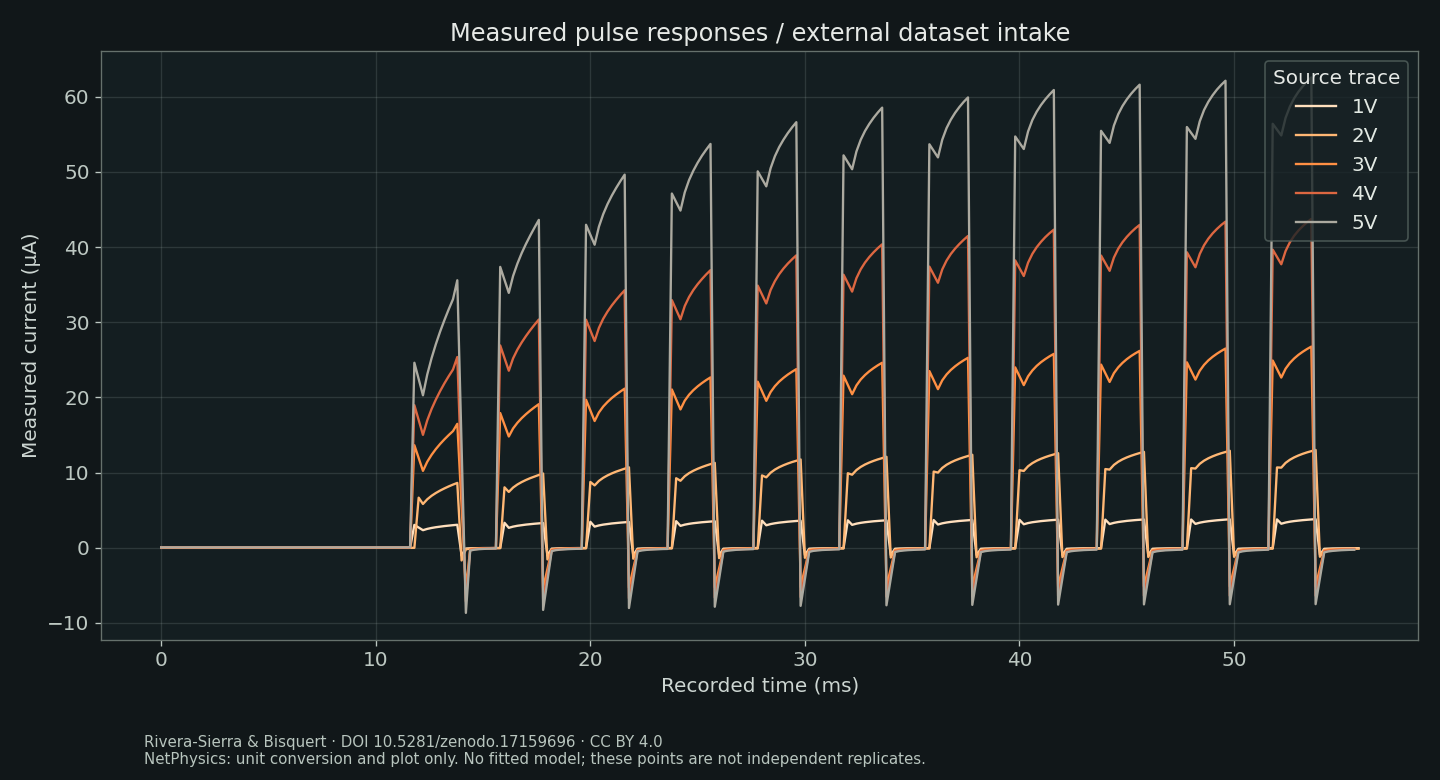
The import preserves source workbook, sheet and row. Its analysis CSV converts mA to A; blank rows are logged. There is no smoothing, outlier rejection or fitted result. Adjacent points are not independent experimental replicates.
Why no performance claim yet: the oscillator has no declared mapping to measured memristor current, independent device/replicate IDs are not supplied in these traces, and some other repository panels are simulated or baseline-adjusted rather than independent measurements. The source authors do not endorse NetPhysics. This is retrospective intake, not prospective preregistration.
The next useful contribution
Provide a documented independent-run dataset or a grounded review of a substrate. Link lawful public material; do not submit confidential or patent-sensitive work.
Review the benchmark →