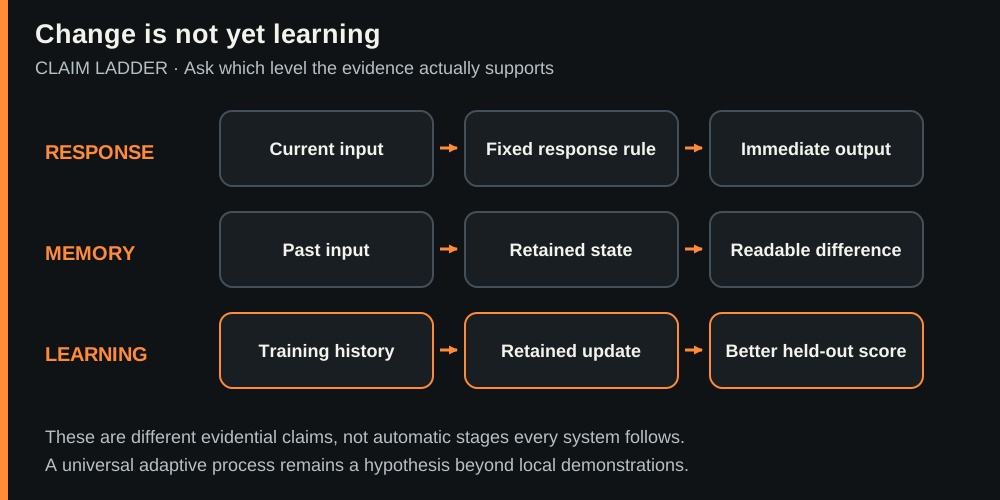
The core proposal is that reality is a nested, adaptive system: geometry shapes interactions, interactions leave information, and retained information influences later behavior across scales. This formulation is a hypothesis, not an established theory of everything. Its strongest unresolved part is the move from demonstrated local mechanisms to a universal adaptive process. Alpha 1, a proposed larger system containing our universe, adds another unverified claim. No observation in this chapter establishes Alpha 1 or its center, rotation, or accessibility. The immediate scientific opportunity is to build limited models in which memory, adaptation, and cross-scale relationships have explicit definitions and measurable consequences.
The model has to earn the word adaptive
We propose representing a bounded system with a physical state, a set of retained variables, and a rule for how those variables change. Then define the task or persistence criterion without choosing it after the outcome is known. Ordinary dynamics may already produce history dependence, so an adaptive model must predict something beyond that baseline. If no task or functional criterion is meaningful at the proposed cosmic scale, the model may still describe changing structure, but calling that change learning would add an interpretation rather than a demonstrated property.
A sequence of tractable questions
First test whether a geometry change affects a physical response. Next test whether experience leaves a readable state. Then ask whether that state causally changes later performance. Finally test whether one mathematical relationship carries across more than one system without ad-hoc adjustments. These are proposed stages, not a record of completed experiments. Local physical-learning research and information-thermodynamics models provide starting tools. They do not remove the need for the cross-scale test, and they do not establish a larger universe merely because they work in a laboratory.
The point at which cosmology becomes necessary
A cosmological extension must state its accessible observables, equations, and compatibility with existing data. If Alpha 1 has no defined influence on observations inside our universe, the present proposal cannot distinguish it empirically from alternatives. That limitation should be stated directly. We propose allowing the research framework to succeed through useful local results even while the largest claims remain open. A genuine advance would be a reproducible prediction or tool, with negative results retained, rather than a narrative that treats every possible observation as confirmation.
The mathematical lens
Proposed model architecture, not a derived fundamental equation. Specify F, G, units, and observables before testing.
Turn it into a question.
- Question
- Does a retained-state model make successful predictions that ordinary dynamics do not?
- Method
- Develop a bounded model, preregister a distinguishing prediction, and replicate it across independent systems.
- What would count against it?
- Equal or worse predictive performance, or an unobservable Alpha 1 extension, leaves the universal claim unsupported.
Begin with a mechanism that can fail a test; let broader scope be earned.
Follow the original work.
These sources support the mechanisms and limits discussed here. They do not endorse Hill’s framework. Notes distinguish research proposals, reviews, and observations.
Continue the investigation
Edition 02 · 18 October 2026 · AI-assisted synthesis. See editorial method.