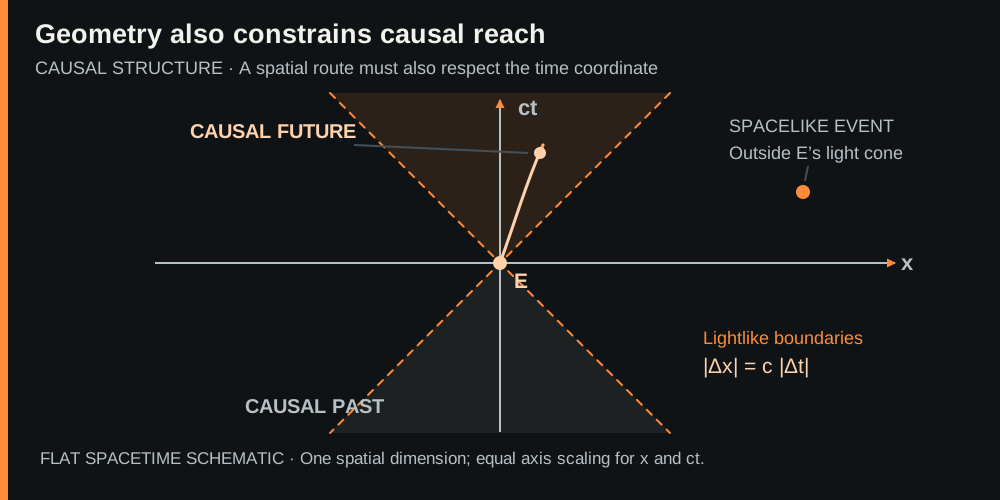
A spacetime diagram is not just a map of where things are; it also specifies which events can influence one another. Light cones organize those relationships locally. A massive observer’s ordinary trajectory remains timelike, while light travels along null directions in the appropriate limit. Hill’s idea of moving between geometric points therefore needs a distinction between a point drawn on a model and an event a traveler could reach. Zooming from Earth to Alpha 1 is an explanatory interface. It does not establish a continuous, physically accessible route between the displayed levels.
Past and future are physical restrictions
In a simple flat-spacetime example, an event outside another event’s light cone cannot be reached by a signal traveling at or below the speed of light. Curved spacetime complicates global relationships but does not remove the need for a local causal specification. The project should display travel proposals with a departure event, arrival event and trajectory, along with the metric assumed. A shortcut drawn in an external embedding can be misleading if that external direction is not part of the physical spacetime.
Correlations do not erase the cones
Quantum entanglement gives nonclassical correlations, yet the standard theory does not turn them into freely controllable signals outside the ordinary causal structure. This distinction should appear wherever the atlas connects information with geometry. A proposed new channel must provide an operational protocol: what does the sender choose, what does the receiver observe, and how is the result distinguished from shared randomness? Without that protocol, a claim of instantaneous connectedness is not a demonstrated communication or travel mechanism.
Test the model before interpreting its picture
A useful research submission would compute the causal paths of a candidate metric, identify horizons or problematic regions, and state whether the spacetime admits a consistent initial-value formulation. If it contains closed timelike curves, the proposal must confront their implications rather than quietly using them as a feature. These are mathematical checks before engineering feasibility. Hill’s project can make progress by publishing failed constructions and the constraint that defeats each one. That record clarifies exactly what a later successful model would need to overcome.
The mathematical lens
In flat spacetime, ds² < 0 is timelike, ds² = 0 is null and ds² > 0 is spacelike, using the stated sign convention.
Turn it into a question.
- Question
- Is the proposed journey a physical causal path in its own specified metric?
- Method
- Compute the trajectory and local light cones, identify horizons and check initial-value consistency.
- What would count against it?
- The route uses an embedding direction absent from the model or crosses a causal boundary without a defined mechanism.
A destination in a visualization is not automatically a reachable event.
Follow the original work.
These sources support the mechanisms and limits discussed here. They do not endorse Hill’s framework. Notes distinguish research proposals, reviews, and observations.
Continue the investigation
Edition 02 · 18 October 2026 · AI-assisted synthesis. See editorial method.