 Concept study / Information & adaptation
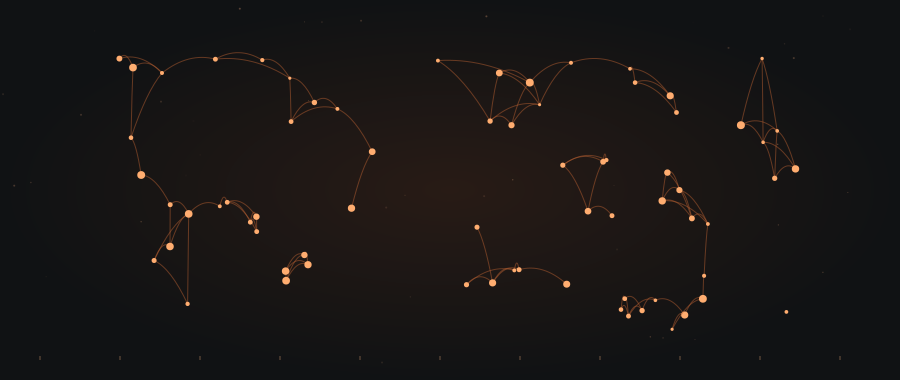
Conceptual illustration. Shapes, colors, and motion are not measured data.
DNA is a physical molecule whose sequence participates in biological inheritance and cellular function. The complementary structure described by Watson and Crick suggested a mechanism for copying sequence information. That makes DNA a powerful example for Hill’s question about records carried through physical processes. It does not show that the same literal code is distributed throughout nonliving matter or that all systems contain a complete blueprint of the universe. The project should distinguish a shared biological inheritance system from a proposed universal organizing principle. The former is supported by molecular evidence; the latter needs its own variables, transmission mechanism, and discriminating observations.
What a blueprint leaves out
For this project, blueprint should remain a metaphor rather than a complete causal model. A sequence has effects through molecular interactions in a particular setting; the same sequence description is not an account of every state of a developed organism. A better research diagram would show stored sequence, copying, regulation, cellular machinery, and environmental inputs as separate elements. That structure allows contributors to ask which information is inherited, which is produced during development, and which is supplied by current conditions.
A fair cross-domain comparison
We propose comparing DNA with an engineered memory only on explicitly matched functions: encoding, copying fidelity, error handling, and state-dependent readout. This can reveal useful shared abstractions without implying identical chemistry or purpose. To extend the comparison to cosmology, one would have to identify corresponding physical operations rather than simply assign familiar biological names to unknown structures. A recurring geometry alone does not identify a sequence, a copying mechanism, or a decoder. Those missing elements should remain visible in the hypothesis record.
How to make the universal claim testable
A universal-blueprint proposal should predict a specific relationship that ordinary shared laws and local history do not already explain. We suggest beginning with a limited question: does a proposed encoding rule predict withheld structures in a new domain with fewer adjustable assumptions than the baseline? Freeze the rule before testing. If it must be rewritten for every example, it is functioning as a descriptive metaphor. A failed mapping can still teach the project which features of biological information were essential.
The mathematical lens
Conceptual dependency map, not an equation for predicting an organism.
Turn it into a question.
- Question
- Does a proposed cross-domain encoding predict new cases?
- Method
- Freeze the mapping and evaluate withheld examples against a simpler baseline.
- What would count against it?
- A mapping that requires case-by-case reinterpretation does not establish a common blueprint.
Biological inheritance motivates a question; it does not answer the cosmic version.
Follow the original work.
These sources support the mechanisms and limits discussed here. They do not endorse Hill’s framework. Notes distinguish research proposals, reviews, and observations.
Continue the investigation
Edition 02 · 18 October 2026 · AI-assisted synthesis. See editorial method.