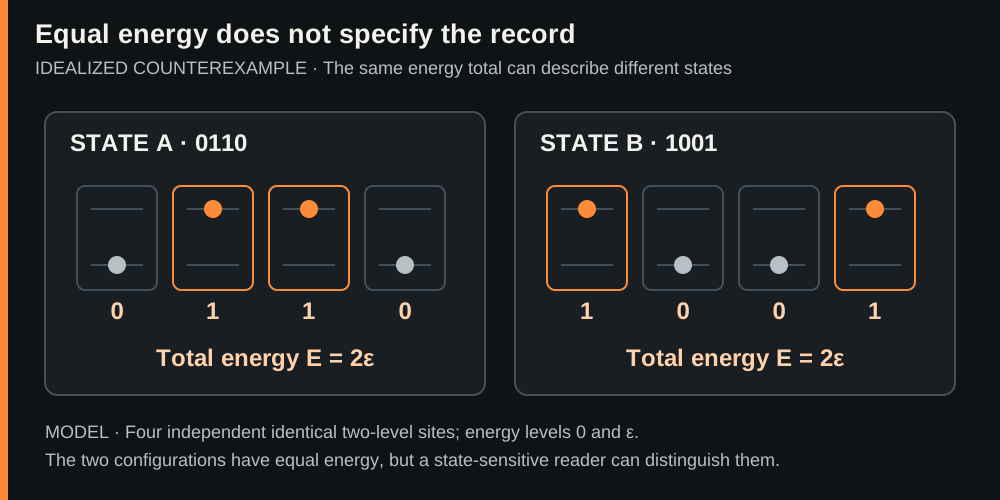
An energy value does not normally specify a complete physical state. A communication signal can carry a pattern while transferring energy, but its content depends on how the signal varies and how a receiver interprets it. This distinction is central to Hill’s proposal. The phrase energy has memory should be replaced, for a testable model, by a statement about which physical degrees of freedom retain a correlation with earlier events. Renaming energy would not resolve the issue; it would risk losing a well-defined quantity that makes calculation possible. A new term should identify a new measurable role rather than obscure an existing one.
Information can change what work is available
Sagawa and Ueda’s feedback framework shows how information obtained by measurement enters thermodynamic relations for controlled systems. A controller can use a measurement to choose a useful action. The accounting still includes the physical system, controller, memory, and relevant reservoirs. This connection does not make information an unlimited fuel. For the project, the important lesson is architectural: identify what is sensed, where the result is stored, and how that record changes the applied protocol. Those connections are the mechanism to investigate.
Three measurements rather than one
We propose reporting energy flow, retained information, and task performance on separate axes. A device might consume more energy while storing less useful information, or preserve a record without using it for control. Combining those outcomes into an unexplained score would hide the result. An interactive model should let users vary the noise, memory lifetime, and driving strength independently where the model permits. The output should show when improved performance costs more energy and when a better design changes the tradeoff.
A stronger version of the hypothesis
A tractable Hill hypothesis is that geometric organization can influence which information remains accessible and how effectively it guides a later response. That statement names an experimental relationship without asserting a new substance. Compare two architectures with the same resources and task, then identify which state changes account for a difference. If ordinary storage and feedback models explain the improvement, the result may still be useful engineering. A new fundamental claim would require an additional, independently tested prediction.
The mathematical lens
Energy costs depend on temperature, operation, state, reliability, and physical implementation.
Turn it into a question.
- Question
- Does geometry improve information use at a fixed resource budget?
- Method
- Compare architectures on separately measured energy, retention, and held-out task performance.
- What would count against it?
- An improvement explained entirely by an increased energy budget does not isolate a geometric information advantage.
Keep energy, records, and usefulness as separate measurable quantities.
Follow the original work.
These sources support the mechanisms and limits discussed here. They do not endorse Hill’s framework. Notes distinguish research proposals, reviews, and observations.
Continue the investigation
Edition 02 · 18 October 2026 · AI-assisted synthesis. See editorial method.