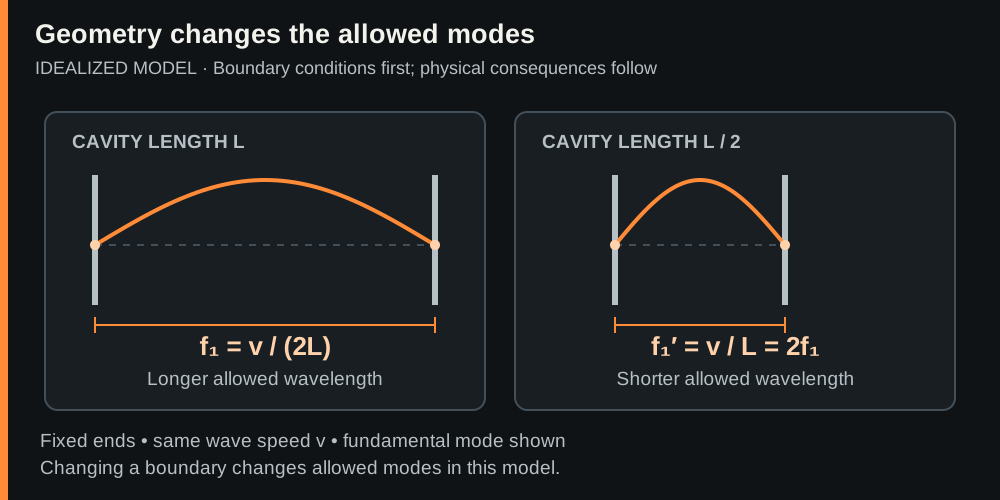
Christopher Hill’s framework begins with an intuition that already has a precise foothold: arrangement matters. A resonator’s dimensions help determine its allowed modes; a distribution of mass affects a gravitational field; the shape of a conductor changes its electrostatic boundary problem. These examples are different physical mechanisms. Grouping them under geometry creates a useful research question, but does not itself supply a common equation. The project’s first task is to say which geometric variable changes, what remains fixed, and which observable responds. A drawing that resembles another drawing is only the start of that specification.
Three meanings of geometry
Physical shape describes boundaries and material arrangement. Spacetime geometry describes intervals and causal relationships through a metric. State-space geometry describes mathematical relationships among possible configurations. These concepts can interact, but they cannot be exchanged without a derivation. Bending a metal plate changes its physical shape; it does not automatically produce useful spacetime curvature. Hill’s proposed connections should name the relevant geometry on every diagram, equation and experiment, so a successful result in one domain is not silently transferred to another.
A bridge that can be calculated
A useful bridge is a parameterized model: choose a shape parameter q and calculate a field, energy or response as q varies. For a conservative mechanical coordinate, the derivative of potential energy determines its generalized force. This supplies a concrete interpretation of geometry changing interactions without treating shape as a source of energy. The energy required to impose or restore the geometry remains inside the experiment’s budget. Material properties, temperature and driving conditions must be specified alongside q.
What would strengthen this framework
The proposed research contribution is a catalogue of successful and failed mappings between geometrical controls and measured responses. Begin with a system whose conventional answer is known, reproduce that answer, then preregister a departure predicted by Hill’s extension. A shared plot should distinguish calculated curves, measurements and conceptual artwork. The framework gains explanatory value if it predicts a new response with fewer adjustable choices, rather than merely redescribing a response after seeing it. This is the standard used throughout the geometry collection.
The mathematical lens
For a conservative generalized coordinate q, Qq is its conjugate force and U is potential energy. Units depend on q; for distance the force is in newtons.
Turn it into a question.
- Question
- Does a specified change in shape predict a response beyond an established boundary model?
- Method
- Fix materials and inputs, preregister the shape dependence, measure multiple geometries and compare a held-out case.
- What would count against it?
- The added effect disappears under calibration or the standard model predicts the held-out case equally well.
Geometry is a productive control variable; its scientific value comes from a defined mechanism and a discriminating prediction.
Follow the original work.
These sources support the mechanisms and limits discussed here. They do not endorse Hill’s framework. Notes distinguish research proposals, reviews, and observations.
Continue the investigation
Edition 02 · 18 October 2026 · AI-assisted synthesis. See editorial method.