 Concept study / Cosmos & scale
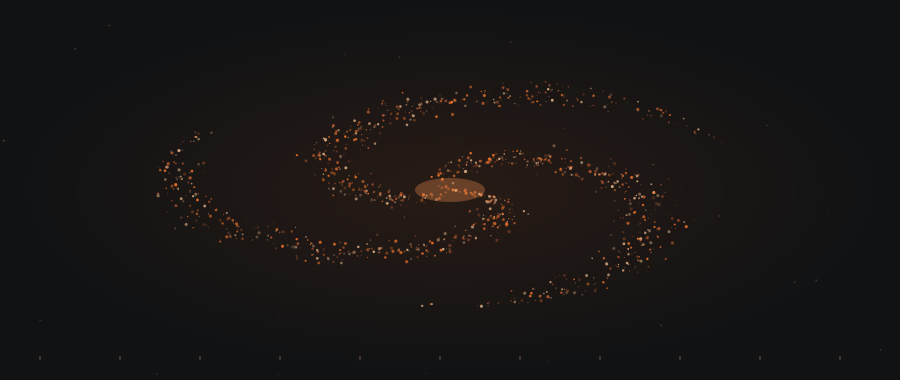
Conceptual illustration. Shapes, colors, and motion are not measured data.
Inflation was introduced to address features of early-universe cosmology such as the horizon and flatness problems. Modern models also connect an early expansion phase with the origin of primordial perturbations. Its scientific content lies in those quantitative predictions, while the underlying mechanism and specific realization remain unsettled. Hill’s theory can use inflation as a model-building comparison: a broad intuition becomes useful when it specifies dynamics and observable consequences. It should not treat the success of some inflationary predictions as confirmation of every larger-system story, because different models imply different behavior and not all imply an accessible parent universe.
A mechanism must do several jobs
An inflationary model must describe how accelerated expansion begins, evolves, and connects to the later thermal history, while producing acceptable perturbations. Guth’s original proposal established the central idea, and subsequent models addressed additional difficulties. For Hill’s framework, the lesson is methodological: specifying a geometry alone may leave the state evolution and transition rules unspecified. A complete candidate needs those rules and must show that its predictions are compatible with observations already explained by the standard cosmological description.
Constraints have names and dates
Planck’s inflation analysis constrains the spectrum and statistical properties of primordial fluctuations. BICEP/Keck’s published 2021 analysis placed an upper limit on the tensor-to-scalar ratio using the observations named in that paper. The atlas cites that result as a dated benchmark, not as a claim to the latest worldwide limit. A non-detection restricts models that require a larger signal; it does not rule out every inflationary model. The same discipline should apply when future tests restrict individual versions of Hill’s hypothesis.
A useful contribution for this project
Write down a candidate expansion history and calculate at least one discriminating perturbation prediction, with assumptions and valid approximations stated. Compare it against a benchmark model and a no-new-effect limit. If the proposal only reproduces an already fitted background curve, identify what further measurement could distinguish it. If it predicts no accessible difference, label it as an interpretation. This turns the project’s ambition into a sequence of tractable comparisons without promising that a single visualization settles early-universe physics.
The mathematical lens
For an expanding background, this condition expresses accelerated expansion in terms of the Hubble rate.
Turn it into a question.
- Question
- Does a specified model produce an allowed and distinguishable primordial spectrum?
- Method
- Derive scalar and tensor predictions, name the approximation, and compare with the precise data releases cited.
- What would count against it?
- A required signal outside the allowed region rejects that model or parameter range.
Test inflationary models individually; do not transfer their evidence to unrelated cosmic narratives.
Follow the original work.
These sources support the mechanisms and limits discussed here. They do not endorse Hill’s framework. Notes distinguish research proposals, reviews, and observations.
- Inflationary universe: A possible solution to the horizon and flatness problemsRead original source ↗
- Planck 2018 results. X. Constraints on inflationRead original source ↗
- BICEP/Keck XIII: Improved Constraints on Primordial Gravitational Waves using Planck, WMAP, and BICEP/Keck Observations through the 2018 Observing SeasonRead original source ↗
Continue the investigation
Edition 02 · 18 October 2026 · AI-assisted synthesis. See editorial method.