 Concept study / Cosmos & scale
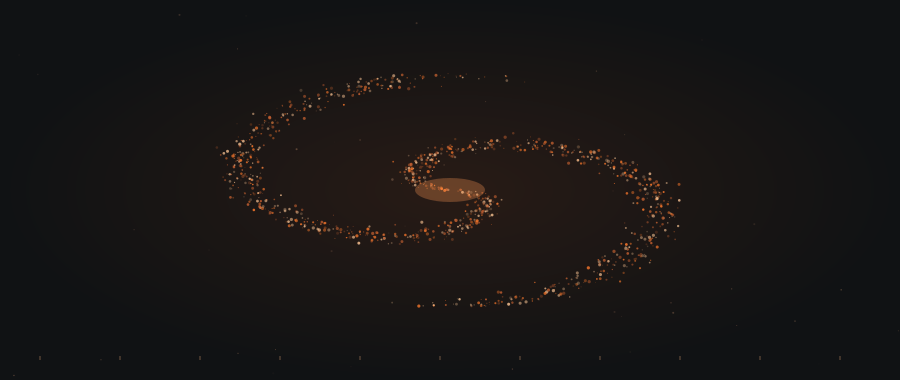
Conceptual illustration. Shapes, colors, and motion are not measured data.
Dark energy names the component or effective description used to explain late-time accelerated expansion in the standard cosmological picture. A cosmological constant is the simplest common model, but alternatives are studied. Hill’s proposal that deeper geometry organizes physical behavior could connect to this question only after specifying how its dynamics changes distances, expansion, or growth. A large conceptual spiral is not an alternative expansion history by itself. The important distinction is between an observed relationship, a fitted model, and the physical mechanism the model is intended to represent. These layers should remain separate throughout the atlas.
A historical result and a modern question
Riess and colleagues’ supernova study provided foundational evidence for acceleration through distance–redshift measurements. More recent DESI baryon-acoustic-oscillation analyses compare expansion histories with additional datasets. DESI DR2 reported preferences for evolving dark-energy parameterizations that vary with the data combination. These are model-comparison results, not a settled identification of a new energy substance or proof that the cosmological constant is impossible. The project should attach the exact dataset and model to a quoted significance instead of presenting one number as universal consensus.
Parameters are not mechanisms
An equation-of-state function can describe how an effective component influences expansion without specifying its microscopic origin. Different mechanisms can produce similar fitted behavior across a limited interval. Hill’s framework must therefore explain what physical quantity is evolving and how it couples to matter and geometry. An additional memory variable, for instance, needs a defined evolution law and consequences beyond a flexible curve. Naming the variable does not establish its existence; the same parameters should also predict another observable with a stated uncertainty.
Build a comparison that can lose
Compare a constant equation of state, a specified evolving model, and Hill’s proposed model using the same likelihood and priors. Publish parameter ranges and a predictive check rather than only the best-fitting line. Model complexity matters because extra freedom can absorb noise or calibration errors. A proposal that cannot be distinguished over the available range should be labeled observationally degenerate. That result can guide future measurements without claiming that present uncertainty supplies positive evidence for Alpha 1 or an adaptive cosmic substrate.
The mathematical lens
A commonly used phenomenological form for an equation of state; it is not itself a microscopic theory.
Turn it into a question.
- Question
- Does the proposed mechanism predict expansion and growth more accurately with justified complexity?
- Method
- Evaluate the same data combinations and priors for baseline and proposed models, including held-out predictions where feasible.
- What would count against it?
- No robust predictive gain, or conflict with another probe, weakens or excludes that parameterized proposal.
Accelerated expansion is evidence; its underlying mechanism remains a research question.
Follow the original work.
These sources support the mechanisms and limits discussed here. They do not endorse Hill’s framework. Notes distinguish research proposals, reviews, and observations.
- Observational Evidence from Supernovae for an Accelerating Universe and a Cosmological ConstantRead original source ↗
- DESI DR2 Results II: Measurements of Baryon Acoustic Oscillations and Cosmological ConstraintsRead original source ↗
- Planck 2018 results. VI. Cosmological parametersRead original source ↗
Continue the investigation
Edition 02 · 18 October 2026 · AI-assisted synthesis. See editorial method.