 Concept study / Cosmos & scale
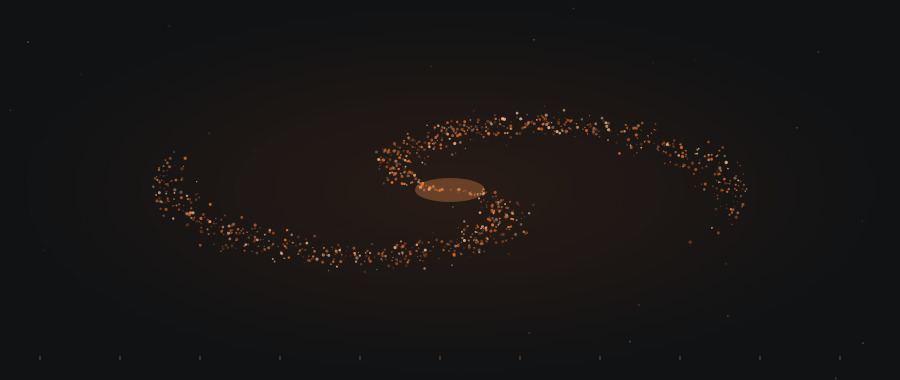
Conceptual illustration. Shapes, colors, and motion are not measured data.
Dark matter is inferred through gravitational effects on motion, light, and cosmic structure. The term names a problem supported by evidence, not a confirmed identification of one particular particle. Hill’s geometry-centered framework may ask whether a deeper account could change that interpretation. Such an alternative is possible to investigate, but it has substantial obligations. It must explain several different observables together and recover successful predictions where they are tested. The fact that a constituent remains unidentified does not establish that the evidence is absent, nor that an unrelated speculative mechanism has already solved the problem.
Evidence is broader than one curve
Galaxy rotation is one line of evidence, but lensing and the growth of structure add other constraints. In the Bullet Cluster, Clowe and colleagues compared the distribution of hot gas with gravitational lensing and found a significant separation between dominant visible plasma and inferred mass concentrations. The result strongly motivates a component whose behavior differs from the collisional gas. A proposed alternative must address this spatial information. Adjusting one galaxy’s velocity profile without predicting lensing and cluster behavior is not a complete replacement.
Geometry is already part of the test
General relativity describes gravitational lensing through spacetime geometry, so saying geometry affects light does not by itself distinguish a new theory. Hill’s contribution would need a different quantitative rule or a new state variable with independently testable consequences. Specify how the rule links the visible matter distribution to lensing, dynamics, and cosmological growth. If each dataset requires its own unconstrained adjustment, a good fit may reflect flexibility rather than a common explanation. Shared parameters and independent predictions make the distinction clearer.
A manageable first research task
Choose a well-documented system and reproduce a published baseline calculation before adding the new rule. Publish data provenance, assumptions, residuals, and the range in which the approximation holds. Then test the same rule on another class of observation without refitting every parameter. This staged program is demanding but concrete. A null or failed transfer is useful because it shows which aspect of the proposal needs revision. The atlas should represent this work as proposed analysis until an actual reproducible result exists.
The mathematical lens
The Newtonian Poisson equation connects gravitational potential Φ with mass density ρ in its domain of validity.
Turn it into a question.
- Question
- Can one proposed geometric rule jointly explain dynamics and lensing?
- Method
- Reproduce a standard baseline, then use a fixed alternative parameterization across independent observations.
- What would count against it?
- Incompatible parameter requirements or failed predictions on independent systems reject that version of the alternative.
An unresolved particle identity does not erase the gravitational evidence.
Follow the original work.
These sources support the mechanisms and limits discussed here. They do not endorse Hill’s framework. Notes distinguish research proposals, reviews, and observations.
Continue the investigation
Edition 02 · 18 October 2026 · AI-assisted synthesis. See editorial method.