 Concept study / Cosmos & scale
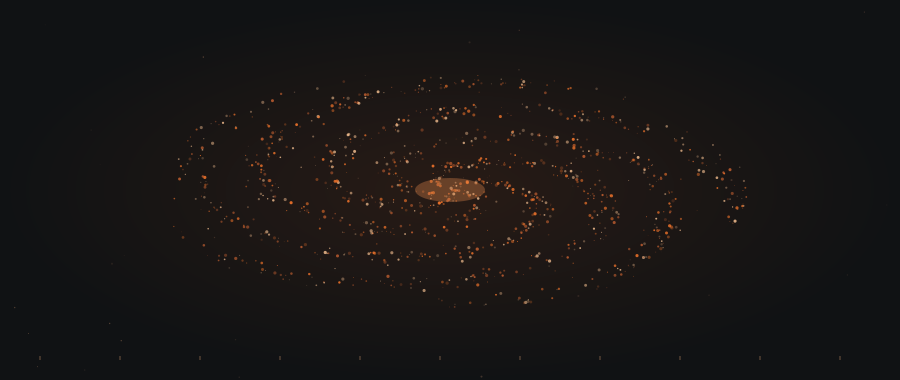
Conceptual illustration. Shapes, colors, and motion are not measured data.
The cosmic web is the name for the large-scale pattern in the distribution of matter and galaxies. It emerges from gravitational evolution of initially small variations, with galaxy formation adding complex observable tracers. Weak gravitational lensing also helps reconstruct mass that does not emit detectable light. Hill’s proposal is naturally drawn to this geometry because networks recur in many settings. A responsible comparison starts by asking whether the same statistics and dynamics recur, rather than treating resemblance to neurons, roots, or a simulated spiral as evidence for the same physical process.
What a web image contains
A survey map is filtered by the objects it can detect, the sky it covers, distance estimates, and the method used to reconstruct density. A simulation has additional choices: initial conditions, resolution, included physics, and display thresholds. The famous COSMOS lensing work reconstructed an underlying mass distribution consistent with cosmic scaffolding. It did not photograph an invisible material directly. Every atlas image should therefore disclose whether it is observation, inferred map, simulation, or conceptual artwork before a viewer interprets its geometry.
Clumping does not remove homogeneity
Strong structure at smaller scales can coexist with a statistical approach to homogeneity when much larger volumes are averaged. These claims refer to different scales and statistics. A filament is not a contradiction of a homogeneous cosmological background, just as a handful of cities does not describe every large region using one local density. Hill’s hypothesis must identify the range over which a fractal dimension or correlation law is expected to persist, and explain any transition rather than assuming limitless repetition.
A useful network comparison
Construct networks using a published rule for nodes, edges, and thresholds. Then compare degree distributions, clustering, path lengths, or spatial correlations against null models that preserve obvious constraints. This proposed analysis could reveal shared mathematical organization without implying shared consciousness or material composition. The stronger claim of a common mechanism would need predictions that distinguish it from generic growth processes. A research contribution should include the threshold sensitivity and unsuccessful comparisons, so a compelling picture is not doing the statistical work.
The mathematical lens
The two-point correlation function measures how density contrast at separated locations is related.
Turn it into a question.
- Question
- Does a claimed cross-scale web similarity exceed a suitable null model?
- Method
- Compare fixed network statistics after matching sampling density, spatial constraints, and reconstruction resolution.
- What would count against it?
- Similarity that disappears under matched sampling or threshold changes does not support a universal mechanism.
Networks can share statistics while arising from different physical processes.
Follow the original work.
These sources support the mechanisms and limits discussed here. They do not endorse Hill’s framework. Notes distinguish research proposals, reviews, and observations.
Continue the investigation
Edition 02 · 18 October 2026 · AI-assisted synthesis. See editorial method.