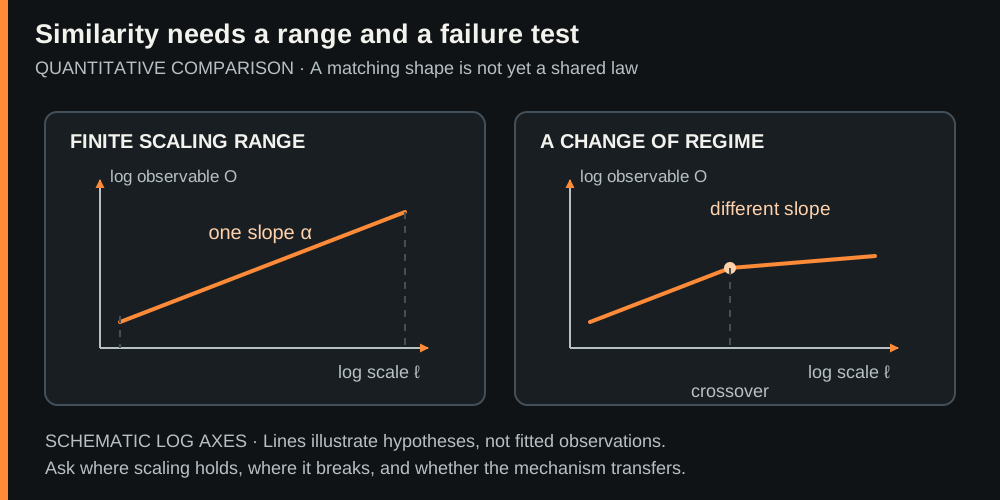
A self-similar object or process retains specified properties under a change of scale. Exact self-similarity, approximate similarity, statistical similarity, and a merely shared visual motif are different ideas. Hill’s theory currently reaches toward both repeated geometry and repeated rules. The strongest research version states precisely what must remain invariant, what may change, and over which range. This prevents any resemblance from counting as confirmation and any mismatch from being explained away afterward. It also makes room for useful partial results: some mechanisms can share mathematics even when they do not describe the same material or level of reality.
Choose a transformation and an observable
A claim needs a mapping from one scale to another and a measurement that remains comparable. Length, mass, time, and state variables may scale differently. A dimensionless ratio or normalized correlation function is often more informative than a raw size. Matching pictures after free rotation, cropping, color changes, and nonlinear warping grants many hidden choices. The comparison tool should record each transformation, then test whether the same mapping predicts properties that were not used to tune the appearance in the first place.
Confront a known place where repetition breaks
Galaxy surveys offer a concrete challenge to unlimited cosmic fractality. Counts-in-spheres analyses find an approach toward three-dimensional homogeneity over their measured large-scale range, even though smaller scales are strongly structured. Hill’s model should either reproduce that transition or state a different falsifiable prediction. The existence of repeated spiral motifs does not override a distribution-level result. Nor does a nearly scale-invariant primordial spectrum mean atoms are miniature galaxies: the statistical property and the physical systems being compared must be named.
A stronger flagship comparison
Select two datasets, preregister a statistic and scale interval, and compare them against null models matched for sampling and resolution. Split the information into discovery and validation subsets. Display resemblance, quantitative effect size, uncertainty, and the baseline side by side. A useful outcome could be a limited universality class or a clear failure of transfer. Both advance the program. A claim that all shapes and all rules repeat everywhere is too unconstrained until these narrower tests specify what observation would make it wrong.
The mathematical lens
A simple scale-invariance relation; the function f, exponent α, scale factor λ, and valid interval must all be specified.
Turn it into a question.
- Question
- Which quantitative property remains invariant under Hill’s proposed scale transformation?
- Method
- Fix a dimensionless statistic and mapping, evaluate independent data, and compare against resolution-matched null models.
- What would count against it?
- A reproducible mismatch or a finite-range break rejects the claimed invariance over that range.
A resemblance becomes a research result when the mapping and failure condition are explicit.
Follow the original work.
These sources support the mechanisms and limits discussed here. They do not endorse Hill’s framework. Notes distinguish research proposals, reviews, and observations.
Continue the investigation
Edition 02 · 18 October 2026 · AI-assisted synthesis. See editorial method.