 Concept study / Cosmos & scale
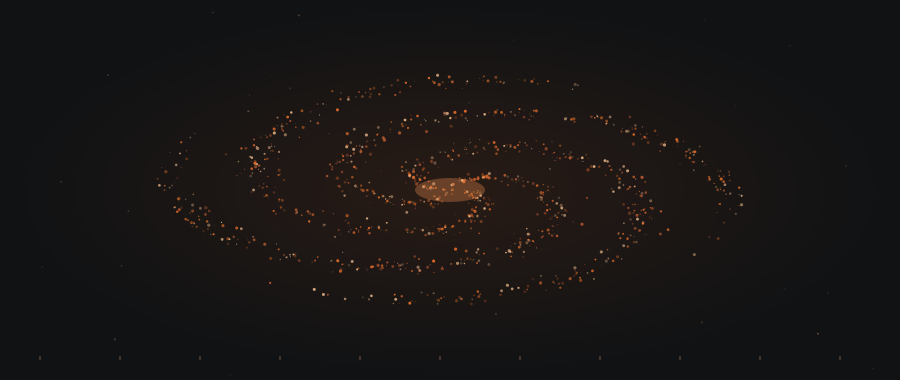
Conceptual illustration. Shapes, colors, and motion are not measured data.
A spiral is a family of geometric patterns, not a single physical mechanism. A rotating source, differential motion, growth rule, wave, or transport process can produce spiral-like structures under different conditions. Hill’s hypothesis highlights these recurring forms and asks whether they reveal deeper common rules. That is a legitimate modeling question when the comparison includes the generation process and measurable parameters. It becomes much weaker if any curved image counts as agreement. The atlas uses spirals as mathematical objects to inspect, while keeping their explanatory status separate from artistic appeal or the assumption of cosmic repetition.
A galaxy arm is not a material hose
The classic density-wave approach describes a pattern that material can pass through. Other numerical studies show transient arms with pattern speeds that vary with radius. These models address why a galaxy can display spiral structure without every arm being a fixed collection of stars expelled from the center. The distinction matters for Alpha 1: an outward-drawn orange spiral does not tell us whether its markers move outward, orbit, pass through a wave, or merely occupy a geometric arrangement.
The curve needs a measurement rule
A logarithmic spiral has a constant pitch angle, while other spiral families have different radial behavior. Fitting one requires a center, coordinate convention, radial interval, and uncertainty. Projection can change the apparent curve, and selecting only convenient segments can exaggerate agreement. Hill’s comparison should report the fitted curve and the residual structure, then ask whether the parameters are predicted independently. A freely chosen pitch angle that can match many images is a descriptive tool, not yet a universal law.
A mechanism comparison worth publishing
Construct two generators that produce similar-looking spirals but have different dynamics. For example, compare a kinematic point pattern with an explicitly evolving wave illustration. Then identify measurements that distinguish them, such as radial transport or radius-dependent pattern speed. This exercise teaches why visual equivalence underdetermines physics. A contributor can improve Hill’s proposal by deriving the extra observable that uniquely follows from its mechanism. If no such observable exists, the spiral remains a useful visualization rather than evidence for the proposed hierarchy.
The mathematical lens
A logarithmic spiral; b controls its winding. This equation defines a shape and does not supply a force law.
Turn it into a question.
- Question
- Does the proposed spiral mechanism predict motion beyond the fitted curve?
- Method
- Measure or simulate both geometry and time-dependent trajectories, with center and projection choices fixed.
- What would count against it?
- A different transport or pattern-speed law rejects mechanism equivalence even if pitch angles agree.
Identical curves can be generated by different physics.
Follow the original work.
These sources support the mechanisms and limits discussed here. They do not endorse Hill’s framework. Notes distinguish research proposals, reviews, and observations.
Continue the investigation
Edition 02 · 18 October 2026 · AI-assisted synthesis. See editorial method.