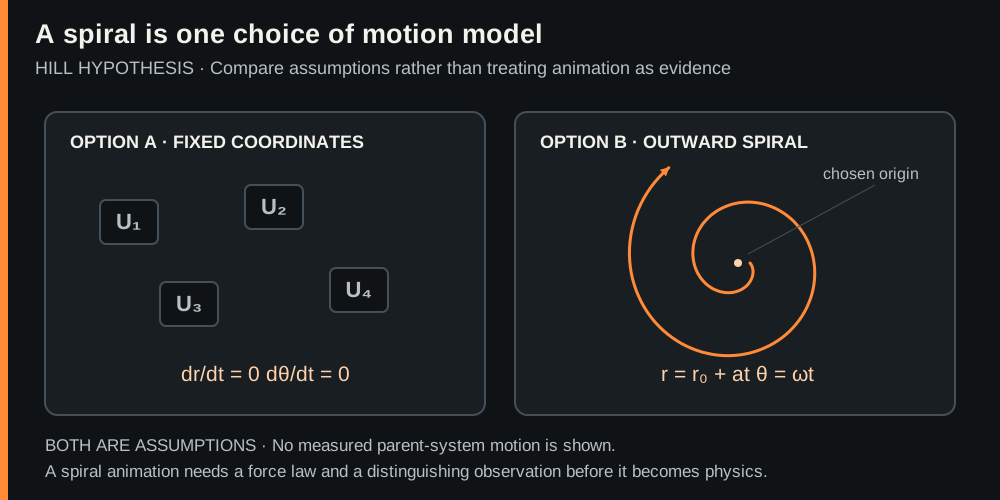
The proposed Alpha 1 spiral is one of the most distinctive visual elements of Hill’s concept. It suggests a relationship between central organization, repeated structures, and outward evolution. At present it is a geometric hypothesis rather than a derived cosmological solution. An outward spiral can describe positions, trajectories, or a propagating pattern, and these are different claims. The atlas must identify which one a control depicts. It should also distinguish a merely rotating camera from physical rotation and avoid implying that galaxy arms demonstrate a similar flow for universes in an external parent system.
Separate arrangement from motion
A collection of points placed along a spiral has no velocity until a time-dependent rule is added. A rotating spiral pattern can move while its constituents cross through it. An outward-moving particle can follow a different path from the curve on which it happens to lie in one frame. Hill’s model needs to specify all three: spatial arrangement, constituent trajectories, and pattern evolution. This separation is not cosmetic; it determines which measurements would test the idea and which conservation equations must be satisfied.
Centrifugal language needs a frame
In a rotating coordinate frame, centrifugal terms can appear in the equations of motion. That description does not identify a new energy source or explain why objects began rotating. A physical proposal must state the interactions, angular-momentum exchange, and valid geometry. If the model extends beyond ordinary spacetime assumptions, those changes need explicit equations. The atlas may demonstrate a kinematic spiral in dimensionless units, but should not attach real speeds, masses, or distances to Alpha 1 without a derivation or measurement.
A tractable first model
Begin with a deliberately simple trajectory generator using a radial growth rule and an angular-speed rule. Label it kinematic, explore its parameters, and show that multiple rules can produce similar snapshots. Then ask what additional observable would distinguish them and how the model connects to our domain. This provides a clear contribution target: replace the assumed trajectory rule with consistent dynamics. Until that step is complete, visual elegance cannot establish a common force law, a mechanism of cosmic learning, or an accessible path to the center.
The mathematical lens
An illustrative kinematic spiral with prescribed α and ω; it is not a derived model of Alpha 1 or cosmic expansion.
Turn it into a question.
- Question
- Can a specified dynamical model generate the spiral while predicting an accessible signal?
- Method
- Supply equations, units, boundary conditions, and conservation checks; derive a prediction distinct from a nonspiral baseline.
- What would count against it?
- Internal inconsistency or failure of a required observable rejects the model; a shape alone remains untested.
A spiral becomes physics when its dynamics and measurements are specified.
Follow the original work.
These sources support the mechanisms and limits discussed here. They do not endorse Hill’s framework. Notes distinguish research proposals, reviews, and observations.
Continue the investigation
Edition 02 · 18 October 2026 · AI-assisted synthesis. See editorial method.