 Concept study / Cosmos & scale
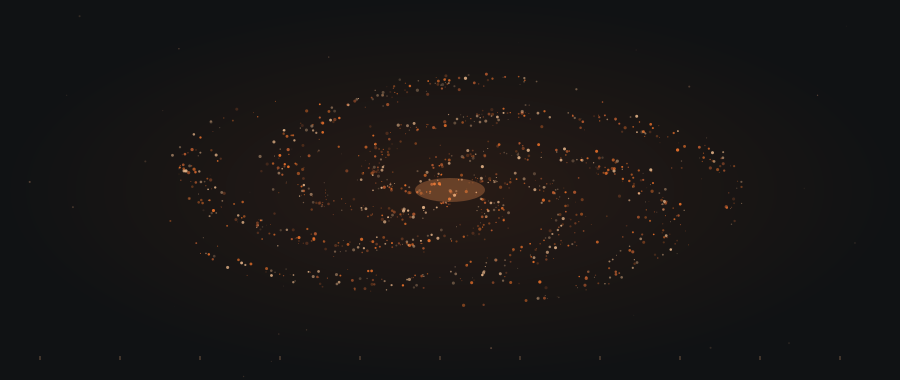
Conceptual illustration. Shapes, colors, and motion are not measured data.
A center can mean several things: the center of a drawn shape, a center of mass, a symmetry point, or the origin of a physical flow. Hill’s Alpha 1 concept currently imagines something central from which a larger spiral organization extends. No observation has located that object or established that the proposed parent system exists. The atlas can explore the geometry without supplying an invented destination. The scientific task is to decide which kind of center is intended, whether it has coordinate-independent meaning, and what information from it could possibly reach an observer in our universe.
Why cosmic expansion does not locate it
Standard homogeneous expansion has no special center within its spatial description. Therefore the observed recession of distant galaxies does not point toward an Alpha 1 origin. The center of our observable horizon is simply tied to our observing location. A physically meaningful parent center would need a different argument: a specified distribution, boundary, symmetry, or coupling that singles it out. Those requirements should be stated before drawing a line from Earth to a glowing point in a conceptual external scene.
Define the measurement before the journey
To estimate a direction or distance, a model must identify a signal and a relation between that signal and the proposed center. It also needs a geometry in which the distance has meaning and a causal description of how information travels. Without them, an arrow labeled toward the center is merely a visual convention. There is currently no demonstrated route, propulsion scheme, or spacetime manipulation that grants access to Alpha 1. The exploratory model should not turn a navigable interface into a claimed travel capability.
A focused research question
Assume a specific, explicitly hypothetical parent influence and calculate the direction-dependent signature it would leave here. Ask whether different observations should infer the same axis and distance-related parameter. Compare with conventional anisotropy sources and instrumental artifacts. A positive anomaly would still require explanation and independent confirmation; it would not uniquely establish a center. If the proposed influence vanishes or cannot cross a causal boundary, the center remains empirically inaccessible. Documenting that limitation makes the next missing step clear for collaborators.
The mathematical lens
A stationary potential point is one possible definition in a suitable model, not a universal definition or a measured Alpha 1 location.
Turn it into a question.
- Question
- What observable distinguishes a physical Alpha 1 center from an arbitrary plotting origin?
- Method
- Define an invariant center criterion and derive a shared directional signature for independent probes.
- What would count against it?
- If the proposed center has no invariant signature or the required pattern is absent, its location is unsupported.
A destination requires a physical model before it can become a route.
Follow the original work.
These sources support the mechanisms and limits discussed here. They do not endorse Hill’s framework. Notes distinguish research proposals, reviews, and observations.
Continue the investigation
Edition 02 · 18 October 2026 · AI-assisted synthesis. See editorial method.