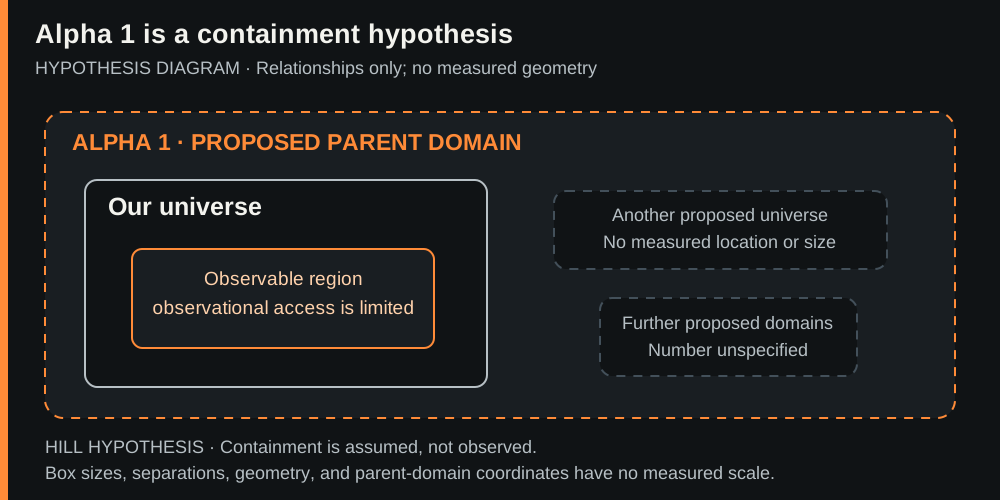
Alpha 1 is the proposed next level beyond our universe in Christopher Hill’s theory. He envisions an immense population of universes, recurring geometric structure, and a wider adaptive process. This is a research hypothesis and conceptual model, not an observed astronomical object. No size, location, center, universe count, or physical rotation has been measured for Alpha 1. The purpose of this page is to make the idea precise enough to improve: identify what it assumes, what existing work can inform it, and what a collaborator would need to supply for an empirical test.
The current claim ledger
The core proposal is parent-system membership: our universe belongs to a larger physical organization. Additional claims include repeated geometry and rules, a central structure, outward spiral behavior, and retained information that influences later evolution. These are separable hypotheses. Evidence for ordinary information retention does not establish cosmic nesting; evidence for galaxy spin does not establish an Alpha 1 axis. The project should track each claim independently so one attractive analogy cannot appear to validate the entire package without the missing physical links.
How the visual model should be read
The Alpha 1 stage uses illustrative coordinates and a limited set of markers to suggest the proposed population. The markers do not constitute measured universes or a population simulation validated against data. Zooming out crosses from astronomical orientation into hypothesis visualization. Camera rotation changes the view only. If a spiral control rearranges markers, it illustrates a geometric assumption rather than a detected force or dynamical solution. This distinction lets the artwork remain ambitious while giving researchers an honest account of what it can establish.
The next contribution that matters
A useful first deliverable would define the parent state, the child–parent coupling, and an observable consequence within our universe. It should also include a no-coupling baseline, dimensional checks, and a parameter range that could fail. Existing multiverse and nesting papers provide comparison cases, not confirmation of Alpha 1. If no accessible observable follows, the model remains conceptual. That is an acceptable current status, provided the site states the gap and invites a derivation instead of announcing that the hypothesis has been demonstrated.
The mathematical lens
A proposed observable must specify the correction ΔO and its parameters; this expression is a research template, not a derived law.
Turn it into a question.
- Question
- What measurable difference would Alpha 1 make inside our universe?
- Method
- Define one coupling and derive a numerical prediction against an established baseline before inspecting the target data.
- What would count against it?
- A sensitive null result rejects the specified coupling range; an unspecified effect is not yet falsifiable.
Alpha 1 is an explicit hypothesis awaiting a mechanism and a discriminating prediction.
Follow the original work.
These sources support the mechanisms and limits discussed here. They do not endorse Hill’s framework. Notes distinguish research proposals, reviews, and observations.
Continue the investigation
Edition 02 · 18 October 2026 · AI-assisted synthesis. See editorial method.