 Concept study / Cosmos & scale
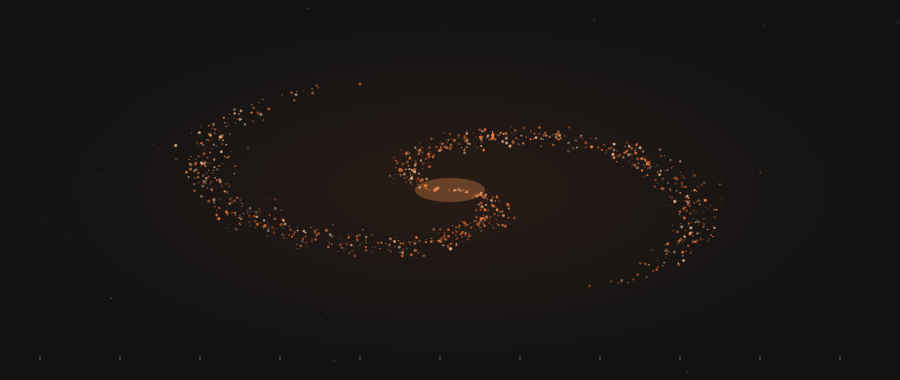
Conceptual illustration. Shapes, colors, and motion are not measured data.
Hill proposes that our universe occupies a larger system, Alpha 1, in a way analogous to a galaxy occupying the universe. The analogy is easy to visualize but physically ambiguous. A galaxy is a region within an observed spacetime; a proposed child universe might instead be causally separated, connected through a mathematical extension, or defined by an entirely different construction. These possibilities have different observational consequences. The first modeling step is therefore to decide what inside means. Without that definition, assigning locations, sizes, or routes between universes risks importing familiar spatial intuition where it may not apply.
A relevant theoretical precedent
Popławski’s torsion-based cosmological proposal discusses a possible connection between a collapsing black hole and a new universe. It provides a mathematical example for comparing parent–child ideas, not observational confirmation that our universe formed this way. The presence of a published precedent also means the broad idea of nested or parent universes should not be advertised as uniquely new. Hill’s distinctive contribution would need to lie in a specified mechanism, prediction, or useful synthesis that can be evaluated on its own merits.
Three meanings should stay separate
Geometric embedding is a mathematical description; causal connection concerns which events can exchange signals; material containment concerns how components occupy a common physical system. One does not automatically establish the others. A drawing of a sphere inside another sphere may imply all three even when a model supplies only one. The atlas should therefore label its nesting as conceptual unless a particular model is selected. Any quoted parent radius or separation would need a metric and an observational or theoretical derivation.
A minimum viable physical model
Specify the spacetime or effective state description, the relation between parent and child variables, and the boundary or transition conditions. Then identify a conservation statement or field equation that remains meaningful across the proposed connection. Finally derive an accessible consequence or explain why none exists. This is a proposed research sequence, not a completed derivation. It would give collaborators a concrete place to contribute and allow different nesting ideas to be compared without presenting all of them as interchangeable support for Alpha 1.
The mathematical lens
This is a modeling placeholder: F must be derived or explicitly postulated before the nesting proposal predicts anything.
Turn it into a question.
- Question
- Does the proposed parent–child relation imply an observable inside our domain?
- Method
- Define containment and causal access, then derive one internal prediction using explicit matching conditions.
- What would count against it?
- An inconsistent matching rule or a failed required prediction rejects that version; an inaccessible model remains untested.
Visual containment is not yet a physical parent–child theory.
Follow the original work.
These sources support the mechanisms and limits discussed here. They do not endorse Hill’s framework. Notes distinguish research proposals, reviews, and observations.
Continue the investigation
Edition 02 · 18 October 2026 · AI-assisted synthesis. See editorial method.