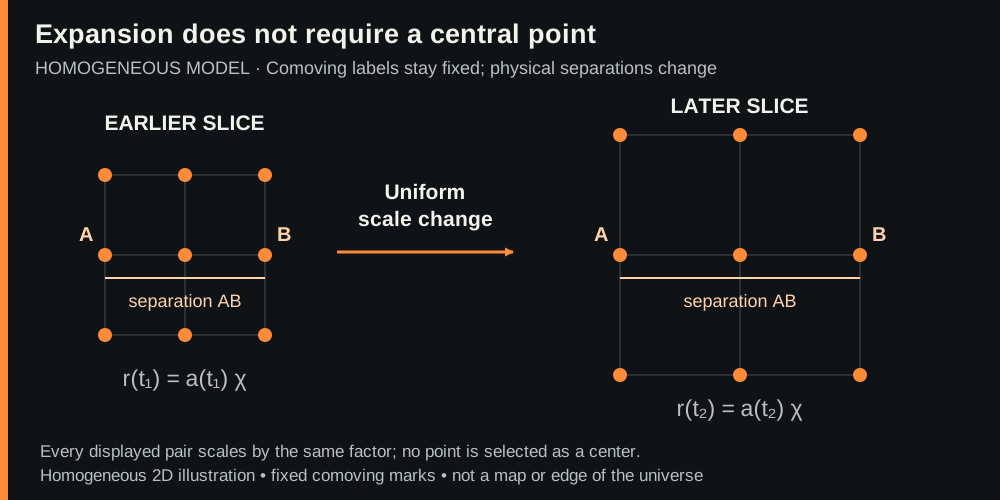
The usual Big Bang model describes an earlier hot, dense state and an evolving spacetime, not an explosion from one location into pre-existing emptiness. In a homogeneous expanding model, many observers can see distant galaxies receding on average. None becomes the special origin of expansion merely by making that observation. This matters directly to Hill’s picture of universes spiraling away from the center of Alpha 1. Such a parent-system center is an optional new structure, not something already established by the expansion of our observed universe or by the rotation of individual galaxies.
Why every location can see recession
Imagine positions labeled by fixed comoving coordinates, with all distances multiplied by the same time-dependent scale factor. The distance between any two such positions changes in the same proportional way. Choosing a different origin changes coordinates without changing this physical relation. This elementary construction demonstrates how expansion can lack a preferred center within space. It does not require treating a balloon’s inaccessible three-dimensional center as a physical part of our universe, an analogy that otherwise easily causes confusion.
Coordinates can create an apparent origin
A plotting program always needs an origin, and a camera always has a viewpoint. Neither choice establishes a physical center. A genuine center would need invariant significance: for example, a specified matter distribution or measurable direction-dependent relation. Hill’s model should state what an observer could detect that distinguishes the center from a convenient coordinate choice. If all predictions remain unchanged when the chosen center is moved, the apparent center is a feature of the drawing rather than a testable physical claim.
A constructive way forward
Develop the simplest center-bearing model as an explicitly separate alternative, then derive its observable differences from a homogeneous reference. This may involve anisotropic distances, peculiar velocities, or a direction-dependent background, depending on the proposed coupling. The prediction must include where the observer sits and which signals can reach them. If Alpha 1 is causally disconnected and leaves no measurable imprint, its center cannot presently be located experimentally. That is a defined limitation, not a reason to invent a direction for travel.
The mathematical lens
For fixed comoving separation χ, expansion follows the scale factor and needs no preferred spatial origin.
Turn it into a question.
- Question
- Does a proposed center have an observable signature?
- Method
- Derive a coordinate-independent prediction and compare it with a center-free baseline using identical data.
- What would count against it?
- If translating the center changes no observable, it is not an empirically identified center.
A center in a diagram is not necessarily a center in nature.
Follow the original work.
These sources support the mechanisms and limits discussed here. They do not endorse Hill’s framework. Notes distinguish research proposals, reviews, and observations.
Continue the investigation
Edition 02 · 18 October 2026 · AI-assisted synthesis. See editorial method.