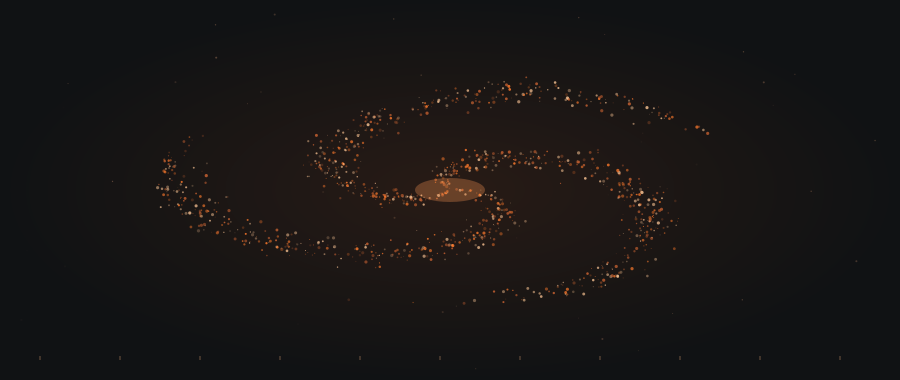
 Concept study / Cosmos & scale
Conceptual illustration. Shapes, colors, and motion are not measured data.
Homogeneity is a statistical statement about how properties change when one averages over sufficiently large regions. It does not say galaxies are evenly spaced or that every volume contains identical objects. The distinction is central to Hill’s belief that nature repeats from the smallest structures to the largest. An exact fractal extending through all measured cosmic scales makes different predictions from finite-range clustering followed by homogeneity. These alternatives can be compared with galaxy counts and correlations, provided survey geometry, selection, distance assumptions, and uncertainty are treated explicitly rather than judged from a dramatic map.
What counts in spheres measure
For a uniform three-dimensional distribution, the expected count within radius r scales as r cubed. A fractal-like distribution can exhibit a different slope over a defined interval. WiggleZ measured a transition toward the homogeneous value using a stated one-percent criterion; Hogg and colleagues provided an independent test with luminous red galaxies. Their exact scale estimates depend on sample and definition. The scientifically useful point is the observed transition, not a universal boundary beyond which every region becomes perfectly featureless.
A threshold is not a law of nature
A homogeneity scale must be defined operationally. Changing the tolerance, tracer population, statistic, or treatment of boundaries changes the reported crossing point. That does not make the analysis meaningless; it makes its definitions essential. Hill’s project should publish the chosen interval, estimator, random catalog, and sensitivity tests. A single fitted slope over a convenient short range cannot establish scale invariance everywhere. Conversely, finding a large individual structure does not alone refute a statistical result about the full sampled distribution.
The strongest version of Hill’s next step
Replace the unrestricted claim with a family of explicit alternatives: finite-range self-similarity, discrete preferred scale ratios, or a transition governed by a specified mechanism. Each can make a different prediction for the slope as the counting radius changes. Compare them with simulations processed through the same survey selection. A good result might identify where similarity breaks and why. That is valuable progress toward a theory of scale, even if it rules out the initial picture of exact repetition without limit.
The mathematical lens
For a homogeneous three-dimensional sample after selection correction, the correlation dimension approaches 3.
Turn it into a question.
- Question
- Does the proposed fractal law persist across the declared scale interval?
- Method
- Estimate counts-in-spheres with survey-matched random catalogs and compare model predictions across several independent samples.
- What would count against it?
- A robust transition to a different slope rejects an unbroken fractal law over that interval.
Finite-scale clustering and large-scale homogeneity can both be true.
Follow the original work.
These sources support the mechanisms and limits discussed here. They do not endorse Hill’s framework. Notes distinguish research proposals, reviews, and observations.
Continue the investigation
Edition 02 · 18 October 2026 · AI-assisted synthesis. See editorial method.