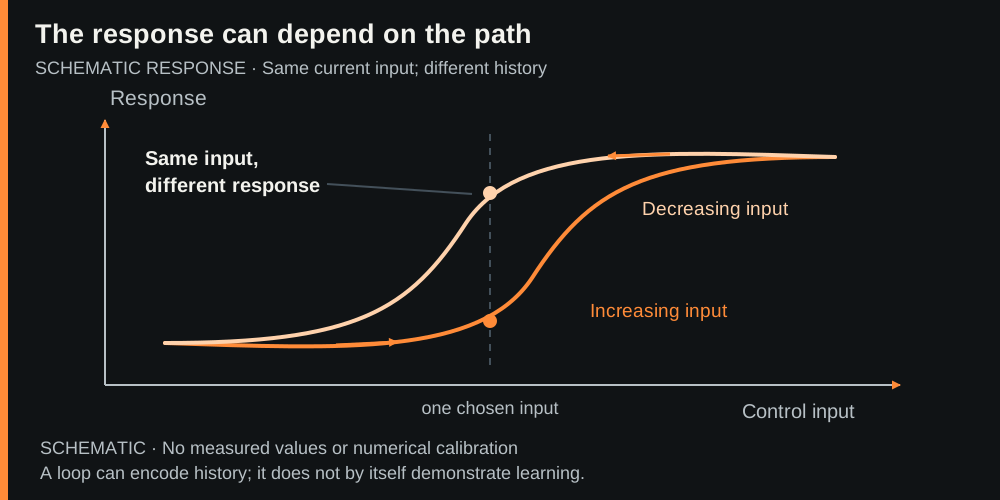
Slowly increase a control input, then reduce it. A hysteretic system can follow different response paths in the two directions. The same current input may therefore correspond to different outputs, depending on earlier conditions. The history can be carried by metastable configurations or other internal variables. Magnetic hysteresis is a familiar setting, but history-dependent responses occur in many materials. For Hill’s project, hysteresis offers an accessible benchmark: it demonstrates how the past can influence the future through an ordinary physical state. It does not, on its own, demonstrate an improvement in performance or a retained model of an environment.
A specific memory mechanism
Sethna and colleagues studied hysteresis and return-point memory in a disordered magnetic model. In the relevant setting, cycling a field through nested reversals can preserve structured information about previous turning points. This is more specific than saying the material remembers everything. The model’s assumptions and allowed driving histories matter. We propose using it as a worked example of a precise claim: identify which feature of an input path is stored, how it is read, and which changes of protocol destroy the property.
Separating a loop from an artifact
A lagging sensor can produce a loop when an input is swept quickly, even when the underlying object lacks the proposed persistent memory. A useful experiment varies the sweep rate, waits at selected points, and measures the sensor response independently. A retained effect that survives an appropriate waiting period differs from a simple measurement delay. The project should report this distinction explicitly. Reproducible loop area alone is insufficient if instrument dynamics, heating, or mechanical backlash have not been considered in the baseline.
Why this does not settle learning
A fixed hysteretic response may be entirely predictable from an unchanged rule. We propose reserving learning for a demonstrable, retained change in how a system handles a defined task after experience. A hysteretic device might form part of such a learner, but the larger architecture and training rule must be specified. Showing both cases side by side would help readers see the distinction: one device records a turning point; another uses a record to improve future performance under a new challenge.
The mathematical lens
Schematic dependence; a mechanistic model replaces history with explicit internal state variables.
Turn it into a question.
- Question
- Does the observed loop reflect retained state or simple delay?
- Method
- Repeat sweeps at multiple rates with dwell periods and independent sensor calibration.
- What would count against it?
- A loop fully explained by measurement lag does not establish the claimed material memory.
History dependence is measurable; learning is an additional claim.
Follow the original work.
These sources support the mechanisms and limits discussed here. They do not endorse Hill’s framework. Notes distinguish research proposals, reviews, and observations.
Continue the investigation
Edition 02 · 18 October 2026 · AI-assisted synthesis. See editorial method.