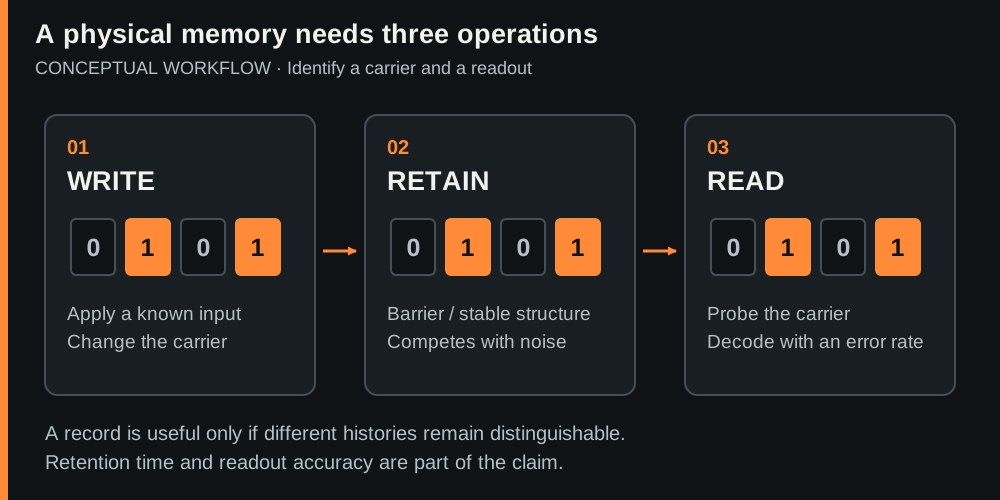
A dent, a magnetized region, or a trained material response can preserve something about the past. The common feature is not that each system thinks. It is that a later observation can distinguish some earlier inputs because the physical state depends on them. Research on memory in matter studies how such records are written, accessed, overwritten, and erased. This is one of the strongest foundations for Hill’s proposal. A precise version asks which state variables preserve history, how long they remain distinguishable, and whether their retention changes future behavior under a controlled probe.
Record, readout, and relevance
The material-memory literature distinguishes many mechanisms and protocols. A retained structural state can encode a previous maximum strain, for example, without preserving every detail of a complete trajectory. We propose recording the scope of a memory claim in a simple sentence: this observable distinguishes these histories over this interval. That sentence prevents a partial record from being described as a complete archive. It also makes comparison possible between very different systems without implying that their microscopic physics is identical.
A training-and-probe design
Prepare multiple specimens or simulations using different histories, then bring their visible external conditions into alignment. Apply a probe whose interpretation was specified before the results are known. Blinding the analysis to the training labels helps separate actual readout from retrospective pattern recognition. Include an untrained group and an erased group. If a temperature cycle or other reset removes the distinction, that result helps identify a storage mechanism. The complete protocol should document damage and drift, which can imitate a retained response.
From memory to the Hill program
The next question is whether the record is merely present or functionally important. We propose selectively disrupting the candidate carrier while preserving other measured conditions, then testing the later response again. A causal effect supports the claim that this record influences behavior. It still would not establish a universal memory law: the mechanism might remain specific to a material and operating regime. That modest result is valuable because it supplies a reproducible bridge from history to state to future response.
The mathematical lens
Proposed retained-information measure between a labeled history and a later measured state.
Turn it into a question.
- Question
- Can a blinded reader recover a past input?
- Method
- Train, match final external conditions, probe, and compare against untrained and erased controls.
- What would count against it?
- Chance-level readout or effects explained by uncontrolled drift undermine the claimed memory.
A material record is evidence of history dependence, not consciousness.
Follow the original work.
These sources support the mechanisms and limits discussed here. They do not endorse Hill’s framework. Notes distinguish research proposals, reviews, and observations.
Continue the investigation
Edition 02 · 18 October 2026 · AI-assisted synthesis. See editorial method.