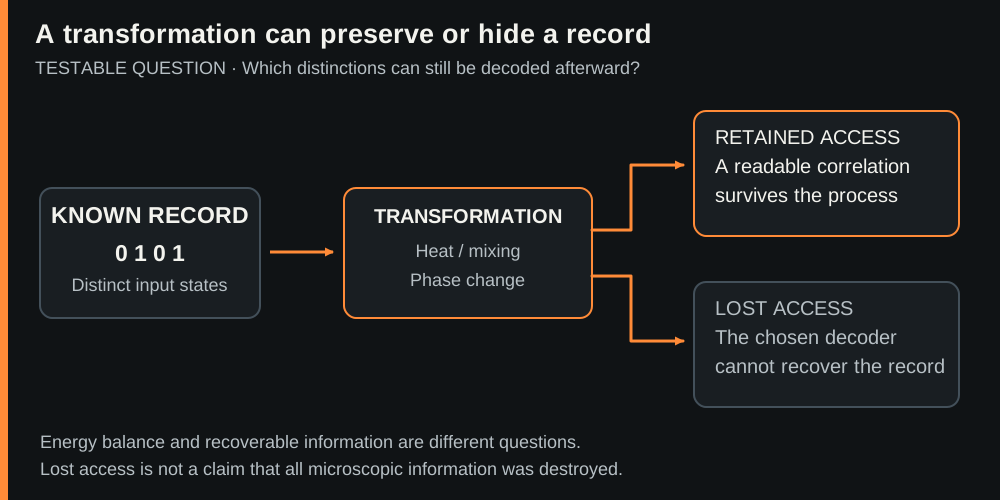
A message can survive a change of physical medium if a process transfers its encoding reliably. The same amount of energy can also pass through a process while a useful record becomes inaccessible. These possibilities are compatible because energy conservation and information recovery are different questions. Hill’s proposed idea that interactions leave traces through transformation therefore needs a defined scope. Does a structural pattern persist through a phase change? Is a particular input recoverable after mixing? Does a correlation survive only in a model with complete microscopic access? Each version leads to a different test and a different standard of evidence.
Preservation is not automatic retrieval
Bennett’s reversible-computation construction illustrates how an operation can preserve distinctions by retaining enough of the computational history. That carefully designed reversibility is different from an uncontrolled transformation in which relevant degrees of freedom disperse into an environment. Even when underlying dynamics are represented as reversible, a practical observer may lack access to the full state. We propose reporting mathematical recoverability and operational recoverability separately. Neither warrants a claim that the energy released by a system carries an accessible copy of its personal or semantic contents.
An achievable material experiment
Begin with a nonbiological model carrying a known random message in a measurable structure. Apply a specified transformation, then ask an independent decoder to recover the message. Include messages assigned after the transformation as a leakage check, and compare with a deliberately erased sample. Record error rates over repeated trials. This proposed design tests a precise retention claim without assuming that every trace matters equally. A partial success should state how many bits remain recoverable and how recovery depends on the transformation strength.
The boundary of the present evidence
Research on material memory supports specific retained properties under specific conditions. It does not establish that personal memories survive destruction of their neural organization, nor that unstructured energy stores such memories. The Hill program should keep those claims separate. A contribution would become scientifically useful by naming a candidate carrier and demonstrating reproducible, content-specific recovery beyond known mechanisms. Until then, broader survival language belongs in a clearly identified hypothesis, with the missing observation stated plainly.
The mathematical lens
Proposed recovery fraction; define the decoder, noise model, and information estimator.
Turn it into a question.
- Question
- Which encoded distinctions survive a particular transformation?
- Method
- Use blinded random messages, controlled transformations, independent decoding, and erased controls.
- What would count against it?
- Recovery indistinguishable from chance or explained by leakage fails the retention claim.
Energy conservation is not a guarantee of memory recovery.
Follow the original work.
These sources support the mechanisms and limits discussed here. They do not endorse Hill’s framework. Notes distinguish research proposals, reviews, and observations.
Continue the investigation
Edition 02 · 18 October 2026 · AI-assisted synthesis. See editorial method.