 Concept study / Cosmos & scale
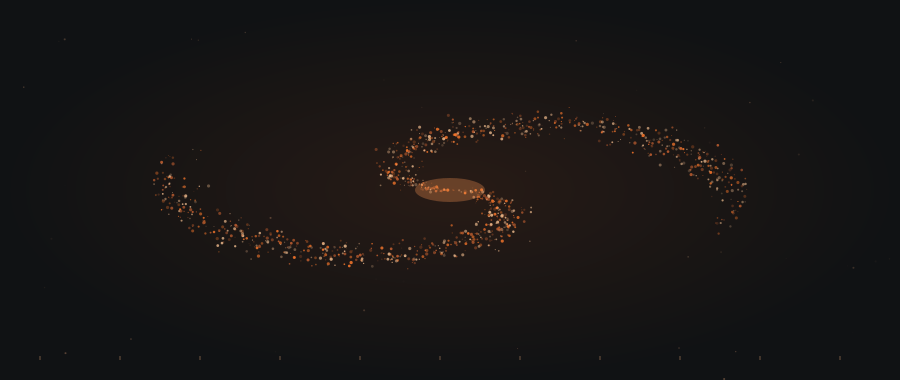
Conceptual illustration. Shapes, colors, and motion are not measured data.
Earth belongs to several overlapping physical systems. It orbits the Sun, moves with the solar system through the Milky Way, and participates in the larger distribution of galaxies. These relationships give the atlas its navigation structure. They do not establish that a planet, galaxy, and universe are identical objects at different magnifications. A useful model must preserve the difference between membership, size, motion, and physical mechanism. Hill’s proposed hierarchy begins with this reliable footing, then asks which relationships could survive a mathematically defined change of scale.
What the scale view represents
The Earth view is a schematic landmark, not a satellite image or a live ephemeris. Earth’s mean radius is about 6,371 kilometers; an equatorial radius is slightly larger because Earth is not a perfect sphere. A display that enlarges the planet relative to its orbit should say so. Without this disclosure, a dramatic zoom can suggest false proportions. The first research habit is therefore simple: attach a quantity, unit, uncertainty, and geometric convention to each visible scale.
Feedback is a starting question
Earth contains coupled atmosphere, ocean, land, ice, and biological systems. Their feedbacks make it a valuable example for discussing adaptation. However, a changing response is not automatically learning: passive feedback can occur without any stored model or improving performance. Hill’s framework becomes more precise if it identifies a state that retains past interactions, a task or constraint, and an observable change in response. The planet provides examples to study these distinctions, rather than proof that the entire cosmos learns.
A useful first comparison
Compare two systems using dimensionless ratios before comparing their silhouettes. For Earth and another planet, ratios such as rotation period to orbital period or atmosphere thickness to radius have interpretable meanings. For Earth and a galaxy, those definitions require additional care because the relevant boundary and dynamical time differ. The project should publish failed comparisons alongside successful ones. That makes the scale journey a route into measurement, and prevents an attractive visual resemblance from silently becoming a proposed universal law.
The mathematical lens
A dimensionless length ratio compares scales without confusing kilometers with light-years.
Turn it into a question.
- Question
- Which Earth properties survive a specified rescaling?
- Method
- Choose a dimensionless property and comparison class in advance, then compare reference measurements with uncertainties.
- What would count against it?
- A systematic mismatch outside measurement uncertainty rejects that particular similarity claim.
Nesting identifies our surroundings; quantitative similarity requires a separate test.
Follow the original work.
These sources support the mechanisms and limits discussed here. They do not endorse Hill’s framework. Notes distinguish research proposals, reviews, and observations.
Continue the investigation
Edition 02 · 18 October 2026 · AI-assisted synthesis. See editorial method.