 Concept study / Cosmos & scale
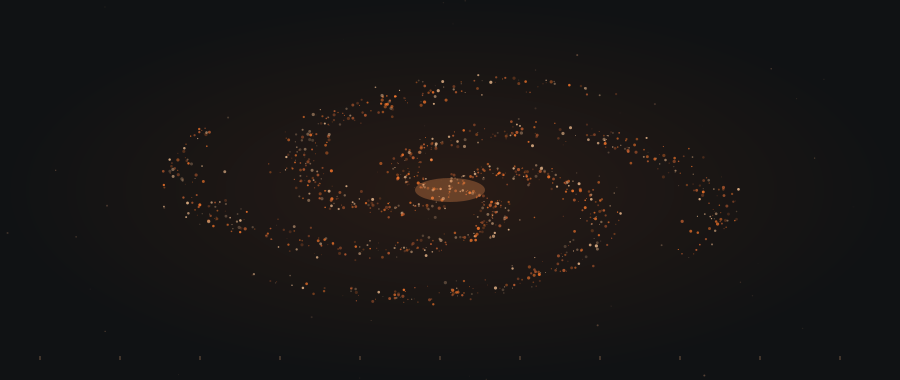
Conceptual illustration. Shapes, colors, and motion are not measured data.
The solar system is not a small picture of the entire universe. It is a gravitationally organized collection centered on the Sun, with planets, moons, smaller bodies, fields, and plasma. A planet’s nearly elliptical orbit differs from the expanding separation of distant galaxies. This distinction matters to Hill’s idea that the smallest and largest systems repeat. The useful question is not whether both pictures contain dots and curves, but whether a transformation carries the equations, parameter ratios, and observables of one system into those of the other.
There is more than one edge
The outermost major planet, the heliopause, and the inferred distant comet reservoir are different boundaries. The heliopause concerns interaction between the solar wind and interstellar medium; it is not the edge of the Sun’s gravity. A scale model should name which boundary it uses. Likewise, an astronomical unit is a distance unit associated with the Earth–Sun scale, not the size of the whole system. Direct navigation labels should keep these distinctions visible when the viewer zooms outward.
Orbits are not outward spirals
Under an ideal two-body approximation, bound planetary motion follows closed conic orbits. Real trajectories receive perturbations from other bodies and additional effects, but a generic outward spiral is not the default description. A rotating camera can make a static diagram appear to spin; physical orbital motion requires a time variable and stated dynamics. In this atlas, camera controls and any simulated time controls therefore have different meanings. Neither control supplies evidence that the universe shares planetary orbital behavior.
What Hill can test here
A controlled starting exercise is to rescale a Newtonian two-body system while adjusting its mass and time units consistently. The transformed orbit can retain its dimensionless shape. This is an example of mathematical similarity within a specified theory, not an argument that every physical domain has the same laws. Introducing radiation, quantum effects, or additional interactions can break the mapping. Recording exactly which assumptions permit the resemblance is a more productive first step than assuming an unrestricted cosmic fractal.
The mathematical lens
For an ideal Newtonian two-body orbit, period T depends on semimajor axis a and the two masses.
Turn it into a question.
- Question
- Can a proposed scale mapping preserve an orbital solution?
- Method
- Specify mass, length, and time scaling; compare dimensionless trajectories under the same two-body equation.
- What would count against it?
- Failure to preserve the governing equation or predicted ratios rejects the proposed mapping.
A rescaled orbit is a legitimate similarity result with explicit conditions.
Follow the original work.
These sources support the mechanisms and limits discussed here. They do not endorse Hill’s framework. Notes distinguish research proposals, reviews, and observations.
Continue the investigation
Edition 02 · 18 October 2026 · AI-assisted synthesis. See editorial method.