 Concept study / Cosmos & scale
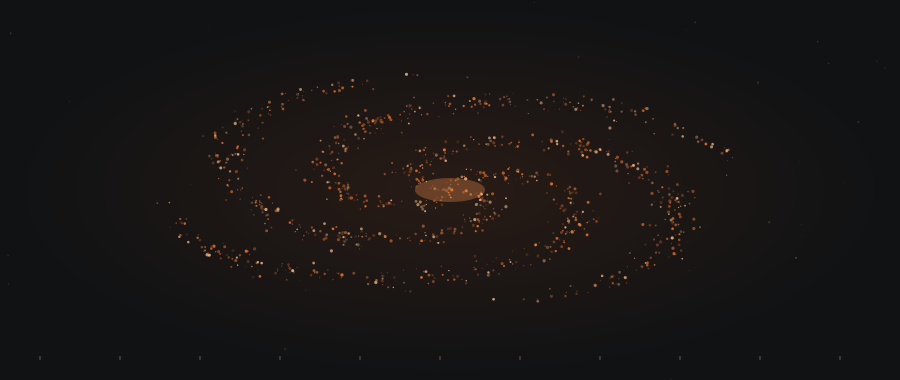
Conceptual illustration. Shapes, colors, and motion are not measured data.
The Milky Way is the galaxy containing our solar system. From inside its disk we reconstruct its structure using many kinds of observations, rather than taking a single external photograph. In the atlas, a luminous spiral is therefore a schematic representation. Hill’s interest in repeated geometry makes galaxies an important comparison case: rotation, collective patterns, gravity, and material distribution interact visibly here. Yet a galaxy is not a rigid wheel, and its spiral arms are not automatically streams expelled from a central source. Those distinctions shape what the visualization can honestly communicate.
An observer inside the structure
The solar system lies away from the Galactic center, in the region commonly called the Orion Spur. Our perspective makes distances and foreground contamination essential to mapping the galaxy. A rendered overhead view compresses this observational work into a picture. It should identify the Sun as a location marker and avoid suggesting that all stars have been measured individually. The central black hole is one component of the galaxy; it does not by itself supply the gravitational mass governing every stellar orbit.
Material and patterns move differently
Stars and gas have motions, while bars and spiral features can have pattern speeds. These are related but distinct quantities. Density-wave models and numerical studies of transient arms offer different descriptions under different conditions. A demonstration can illustrate either, provided it names the model and does not portray it as the only established mechanism. This is particularly important for Hill’s spiral analogy: matching an arm’s visual curve to another structure does not establish a shared angular velocity, transport direction, or cause.
A comparison that earns its meaning
The productive cross-scale comparison is a vector of measurements: mass profile, velocity profile, characteristic times, and dimensionless geometry. A galaxy and a solar system may both be gravity-dominated while having radically different mass distributions. That difference changes their rotation curves. Hill’s framework would gain strength by predicting which dimensionless relationships should match and which should not. An explicit mismatch is informative because it identifies where a proposed universal repetition must be revised or restricted to a narrower physical regime.
The mathematical lens
This circular-speed relation is exact for a spherical Newtonian mass model; a disk requires the appropriate gravitational potential.
Turn it into a question.
- Question
- Does a proposed scaled model predict the galaxy’s velocity profile?
- Method
- Compare the model with a specified rotation-curve dataset, including geometry, distances, and uncertainty.
- What would count against it?
- A systematic radial residual rejects that dynamical mapping even if the images look similar.
A galaxy’s rotation is measurable; transferring it to the universe requires new evidence.
Follow the original work.
These sources support the mechanisms and limits discussed here. They do not endorse Hill’s framework. Notes distinguish research proposals, reviews, and observations.
Continue the investigation
Edition 02 · 18 October 2026 · AI-assisted synthesis. See editorial method.