 Concept study / Cosmos & scale
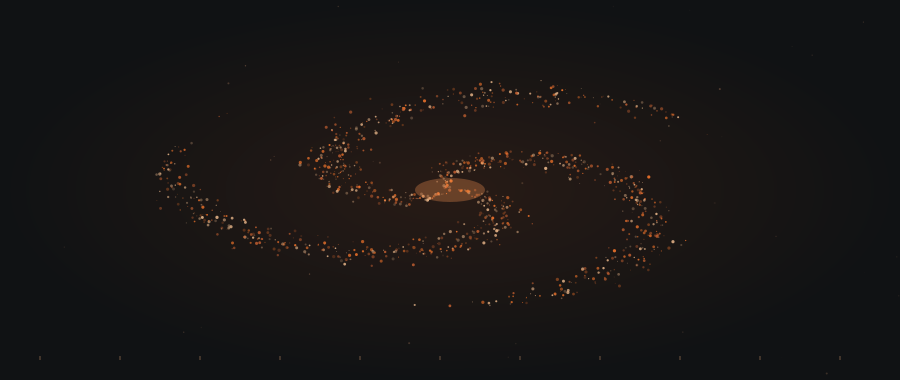
Conceptual illustration. Shapes, colors, and motion are not measured data.
The Milky Way belongs to a gravitational neighborhood that includes Andromeda, Triangulum, and many smaller galaxies. This Local Group is a real level in our astronomical address, but its arrangement is not a giant spiral galaxy. Membership and motion are inferred from observations, with uncertainty for faint or distant objects. The example is useful for Hill’s proposal because it separates two statements that can sound similar: systems can be nested, and systems can be self-similar. The first does not logically establish the second, and a reliable atlas makes that gap explicit.
A group is not a scaled disk
The group contains galaxies with different shapes, sizes, and histories. It does not have a single visible disk analogous to the Milky Way’s stellar disk. Its gravitational dynamics depend on extended mass distributions, velocities, and interactions. A simple cluster of glowing markers is a useful orientation aid, not a solved dynamical model. The number of identified faint members can change with surveys, so the atlas avoids presenting a historical educational count as an exact contemporary census of the group.
Local motion and cosmic expansion
At short enough distances, gravitationally induced peculiar motions can dominate the smooth expansion trend. Consequently, observing a neighboring galaxy approaching does not refute cosmic expansion. It shows that the large-scale background description and local dynamics must be combined. A proposed Alpha 1 spiral must make the same distinction rather than treating every inward or outward velocity as evidence for one universal flow. The relevant comparison is a quantitative residual after accounting for known motions, selection, and observational errors.
Use hierarchy as a measured question
For a cross-scale model, define membership, a characteristic size, and a dynamical state before calculating ratios. A group that is not in simple equilibrium cannot automatically be analyzed with the same assumptions as a settled disk. Hill’s framework could predict a distribution of group properties conditioned on member properties, then compare it with catalogs and simulations. That is a meaningful hierarchy test. Looking only for a resemblance between a selected group image and a selected galaxy image invites selection bias.
The mathematical lens
At low redshift, the observed radial trend combines background expansion and local peculiar velocity; precision work needs fuller corrections.
Turn it into a question.
- Question
- Does nesting alone predict a repeated dynamical form?
- Method
- Compare a preregistered set of galaxy and group descriptors using consistent boundaries and selection.
- What would count against it?
- Different descriptor distributions or failed predictive transfer reject exact self-similarity.
A real hierarchy can have different structures and laws of effective behavior at each level.
Follow the original work.
These sources support the mechanisms and limits discussed here. They do not endorse Hill’s framework. Notes distinguish research proposals, reviews, and observations.
Continue the investigation
Edition 02 · 18 October 2026 · AI-assisted synthesis. See editorial method.