 Concept study / Cosmos & scale
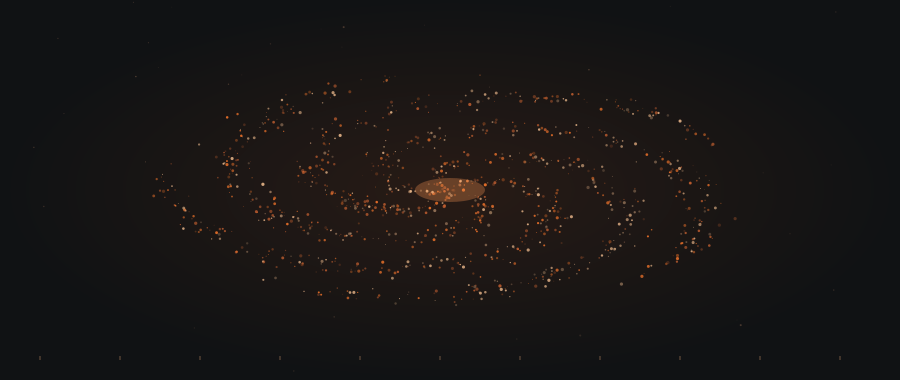
Conceptual illustration. Shapes, colors, and motion are not measured data.
The observable universe is the region from which signals have had time to reach us in our cosmological history. Its present-day diameter is roughly ninety-three billion light-years in standard cosmological models, despite an age near 13.8 billion years, because distances changed while light traveled. The precise value depends on the model and conventions. The entire universe may be much larger, and its total size is not measured. In Hill’s scale journey, this is the point where an observed cosmological domain must be distinguished sharply from the proposed external Alpha 1 system.
Three distances answer three questions
Light-travel time, current proper distance, and comoving distance are not interchangeable. An object seen at an early epoch is shown as it was, while a present-day distance refers to a model of a simultaneous cosmic slice. The atlas should not combine these quantities into one unlabeled ruler. A sphere around the observer can illustrate a horizon, but it is not an observed shell surrounding all existence. An observer elsewhere has a different observable region, possibly overlapping our own.
A boundary to knowledge
A horizon limits access to information; it does not establish a material wall or an outside space. Some regions can be unobservable now yet belong to the same spacetime model. Conversely, another universe in a multiverse proposal may not share the same kind of distance relation at all. Hill’s larger-system proposal therefore needs a definition of containment before assigning Alpha 1 a radius or placing our universe at a coordinate. A visual jump beyond the horizon is conceptual, not an extrapolated measurement.
How to keep the zoom honest
Use a clearly labeled transition at the observable-universe level. Known astronomical distances can guide earlier stages, while the Alpha 1 stage should use dimensionless illustrative coordinates and a persistent hypothesis label. Do not fill an unknown distance with an impressive invented number. A researcher can still manipulate the conceptual model, but must export its assumptions separately from observational data. This design makes the model valuable for defining questions while preventing the interface from presenting an unmeasured parent system as discovered geography.
The mathematical lens
The comoving particle horizon depends on the expansion history; a(t) is the scale factor.
Turn it into a question.
- Question
- Is a displayed boundary a measured horizon or an assumed physical edge?
- Method
- Document distance conventions and recompute the horizon under a specified cosmological parameter set.
- What would count against it?
- An unexplained mismatch or an unsupported conversion to total-universe size invalidates that display claim.
The observable universe is finite; the total size and external embedding are unknown.
Follow the original work.
These sources support the mechanisms and limits discussed here. They do not endorse Hill’s framework. Notes distinguish research proposals, reviews, and observations.
Continue the investigation
Edition 02 · 18 October 2026 · AI-assisted synthesis. See editorial method.